Can you learn rhythm? What tap dance teaches us.
“I’ve got no rhythm." It is one of the most common things adults say before they try tap dance classes, and it also one of the most misunderstood.
Because rhythm isn’t one thing. It is several distinct things, each of which develops differently, and each can be learned.
Understanding what they are changes the question entirely.
Table of Contents
What people mean when they say they have no rhythm.
When someone says they have no rhythm, they are usually describing a specific experience, feeling disconnected from the music, losing their place in the counts, moving too early or too late and not knowing why.
They’re not describing an absence of musical ability. They’re describing a gap between what they can hear and what their body can do, and they don't have the skills to understand what's happening yet.
Research supports what most experienced teachers know, studies consistently show that rhythmic ability responds dramatically to deliberate practice.
Adults with no musical background who engage in structured rhythm training show measurable improvements in beat synchronisation accuracy.
That's worth sitting with for a bit. Most people who believe they have no natural rhythmic ability have simply never been taught how to find it.
Rhythm is not just one thing.
This is where the conversation gets more interesting. In tap dance, rhythm is understood as a number of distinct but interconnected components. Each one develops at its own pace, and each one can be learned.
Time is the structure. In music, time tells you how many beats are in a bar and what kind of note gets the beat. Four beats in a bar, a quarter note to each beat, that's 4/4 time, the most common time signature in popular music. Time is the container everything else sits inside. Most people have more of a feel for this than they realise, they can usually tell when movement to a piece of music feels regular and when something is not right.
Tempo is how fast or slow the music is, measured in beats per minute. Tempo is one of the first things a student becomes aware of in a tap class because the relationship between the speed of the music and the speed of the feet is immediate and audible.
Rhythm, in the specific musical sense, is how you subdivide the beat. A quarter note lands once per beat. An eighth note lands twice. A sixteenth note four times. A triplet divides the beat into three. This is where complexity and interest live. This is the layer that makes tap dance feel like making music rather than just keeping time. It is also the layer that develops most noticeably over weeks and months of consistent practice.
Groove is the vibe or feel of the music, the flow or how the rhythm sits. For example, the difference between a swing groove and a straight groove. The difference between something that flows and something that sounds more measured. Groove is the hardest component to describe and, for most students, the last to really make sense. But it does eventually develop through listening, through playing with the music, and through the accumulation of time spent in the dance studio.
Rushing and dragging are two of the most common experiences
Most adults who feel they have no rhythm are experiencing one of two things: rushing or dragging.
Rushing means dancing ahead of the beat, the feet move before the music asks them to. It often comes from anticipation, from thinking about what comes next rather than landing cleanly in the present moment. Rushing is extremely common and it is not a sign of poor rhythm, it is a sign of a brain working in anticipation of what steps come next.
Dragging means dancing behind the beat, the feet arrive later than the music. This is less common, but tends to develop when a student is concentrating very hard and caution slows the body and mind down.
Neither rushing nor dragging is a rhythm problem in the fundamental sense. Both are timing problems, and timing is trainable.
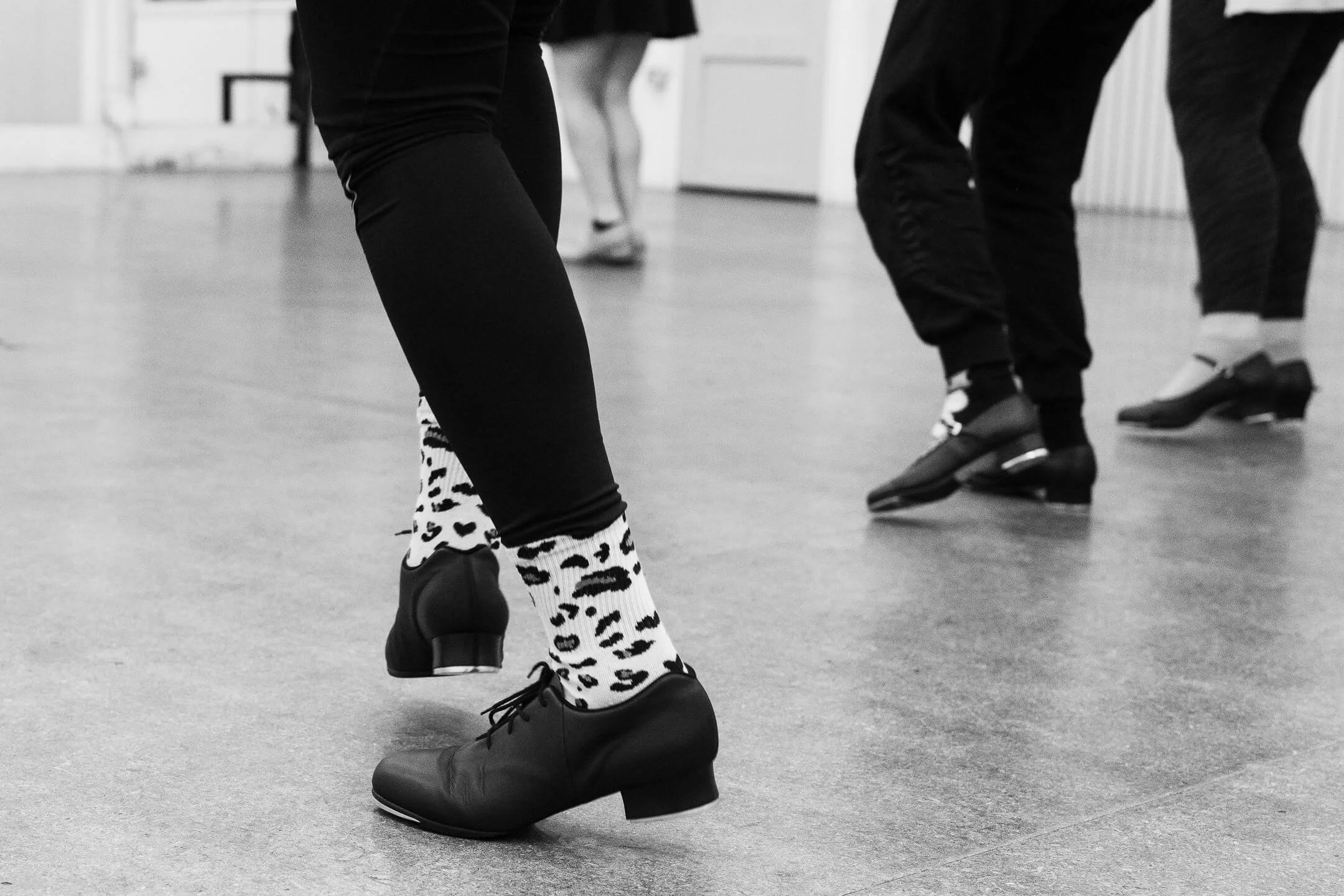
In tap dance, the floor gives you immediate feedback, you can hear exactly where your sound lands in relation to the music. That feedback loop is one of the most effective tools for developing timing that exists. The goal is to practice internalising the beat and tap dance gives you a way to hear yourself doing it in real time.
Is rhythm natural or can you learn it?
The answer is both.
Research tells us that a sense of rhythm is the outcome of both genetics and environment.
Some people arrive to classes with a natural feel for groove or tempo, they find the beat easily and sit in it comfortably from early on. That natural feel is real and it does make certain aspects of early learning easier.
But genetics set a starting point, not a fixed destination. Every component of rhythm, time, tempo, rhythmic subdivision, and groove, responds to consistent practice.
Students who arrive with very little natural feel for the beat can consistently develop it over months of regular classes. The process is not the same for everyone, and the timeline varies. But the development is real.
In tap dance, this process is particularly effective because you can hear what you're doing as you learn. When a shuffle lands on the beat, you hear it. When it doesn't, you hear that too. The feedback is immediate and it is accurate. There is no guessing.
Over time, the ear and the foot learn to find each other, and what felt completely disconnected to start with begins to feel natural.
What changes over time?
A tap class in the early weeks sounds like people learning steps. A few months in it starts to sound like something else — like people making music together. That shift is not about talent. It is about the accumulation of small corrections, consistent attendance, and the gradual process of the body learning to trust what the ear already knows.
Students who arrive saying they have no rhythm are often the same students who, six months later, are the ones holding the beat for the rest of the room. Not because they were hiding a natural gift. Because they stayed, and because staying is what does the work.
Can you learn rhythm? The answer is yes. The better question is how, and tap dance is one of the most direct answers to that question there is.
Frequently asked questions
-
Yes. Rhythmic ability develops through practice at any age. Adults who engage in structured rhythm training, including tap dance classes, consistently show measurable improvement in their ability to find and keep the beat. Starting without a strong sense of rhythm is not a barrier. It is simply a starting point.
-
Both. Research shows that sense of rhythm is influenced by genetics and environment. Some people have a more natural feel for the beat. But every component of rhythm responds to practice, and the gap between where someone starts and where they can get to is almost always larger than they expect.
-
Most students notice a genuine shift somewhere between two and four months of regular weekly classes. The development is gradual and uneven, there are weeks where it clicks and weeks where it doesn't. Showing up regularly matters more than any natural starting point.
-
Losing the beat is usually a timing issue rather than a fundamental rhythm problem. The most common cause is rushing, moving slightly ahead of where the music asks you to be. This is extremely common in adult beginners and it improves steadily with practice. Tap dance is particularly effective for addressing it because you can hear exactly where your sound lands in relation to the music.
Ready to give it a go?
Book a class now and start tap dancing your way to fitness and rhythm!
If you’re in Melbourne (Australia) and you’re new to tap, explore our dance classes for beginners to find a tap class that suits you. Or if you’re thinking about returning to tap dance explore all other classes here.