What No One Tells You Before Your First Adult Tap Dance Class.
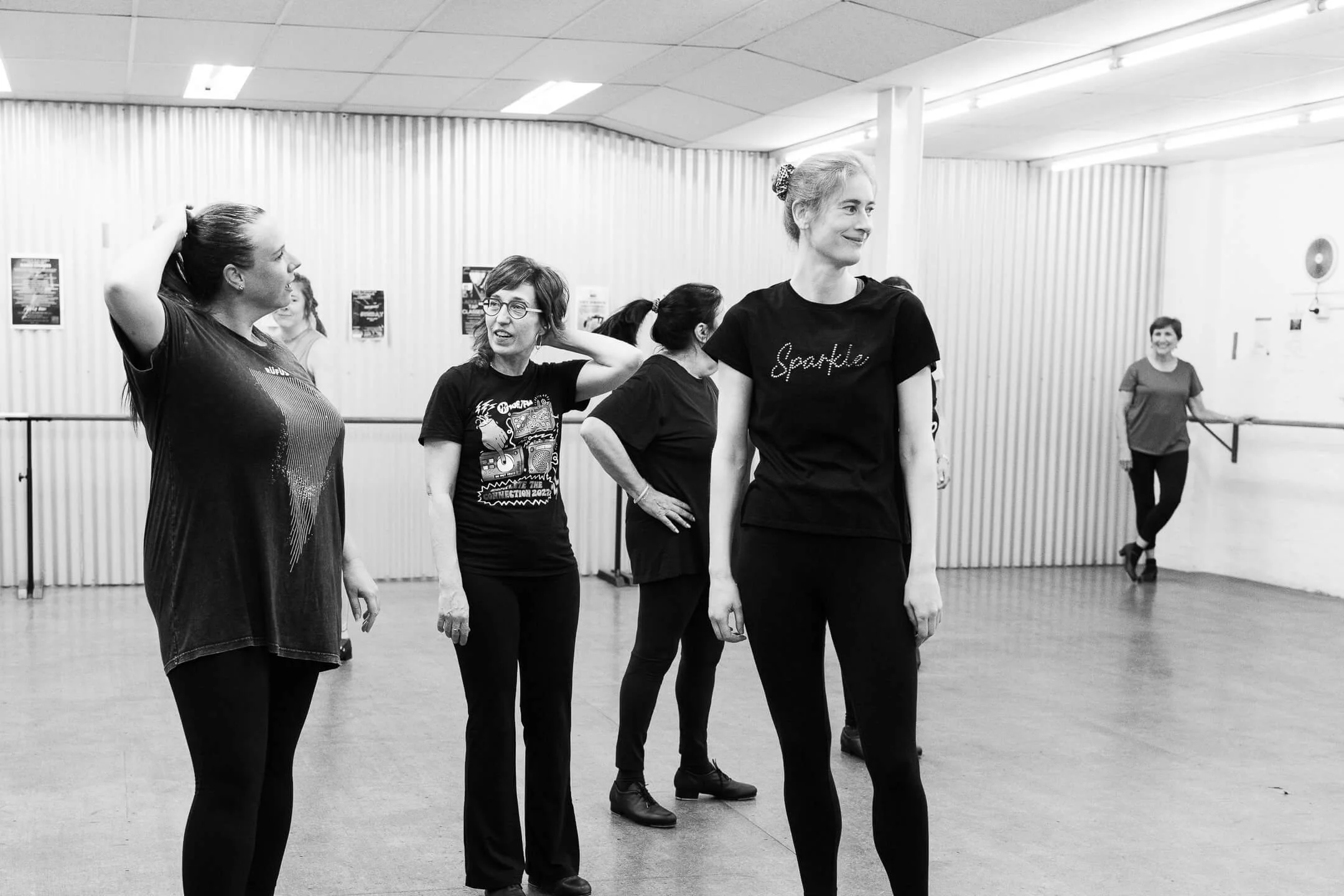
Tap dance legend Honi Coles once said, "if you can walk, you can tap dance." If someone had told me that before my first adult tap dance class, I'm not sure I would have believed them. Two minutes in, I did.
That's the thing about tap dance. It has a way of surprising you before you've even had time to really think about it.
If you've been thinking about trying tap, and something tells me you have, here's everything you need to know before your first tap class.
Table of Contents
Before you arrive
Let's start with the practical stuff, because not knowing the basics is one of the things that stops people from booking in the first place.
What to wear is simple. Comfortable clothes you can move in. Nothing special, nothing you'd be afraid to sweat in. Most people show up in what they'd wear to a workout class or a casual walk. That's perfect. Oh, and layers are a good idea so that you can strip off a layer as you warm up.
Shoes. You don't need tap shoes for your first class. A flat lace up shoe with a leather sole would work and if you don’t have any runners are fine.
If you decide tap is for you, and there's a reasonable chance you will, tap shoes are the next step. But not yet.
What to bring. Just yourself and a water bottle. That's genuinely all.
What actually happens in your first tap dance class
Here's the class, start to finish, so nothing catches you off guard.
You'll start with a warm up. Nothing intense, just enough to get the body moving and the mind switched on. It sets the pace for everything that follows.
Then comes technique. Your teacher will introduce new tap steps, or work through steps the class has been building on. You'll learn how to execute each step, what the foot and leg is doing, where your weight should be, what the upper body is doing, and why it sounds the way it does. This is where the real learning happens.
Across the floor work follows, travelling combinations that get the cardio going and give you the chance to put new steps together with the ones you already know.
And then routines. This is where everything comes together. You'll start linking steps into short sequences, learning how to move from one combination to the next, and you’ll end up with a short routine.
That part feels like a genuine achievement, because it is.
A little tap dance vocabulary
You don't need to know any of this before you arrive. But having a few terms in your back pocket means you'll spend less time decoding what's being said and more time actually dancing.
Heel drop — a one sound step. The heel comes off the floor and then drops to the floor to make a sound. Sounds simple. Feels satisfying.
Toe drop - a one sound step, the toe lifts off the floor and then drops back down again.
Heel dig - a one sound step. The whole foot comes off the floor and the heel digs into the floor slightly in front of you.
Toe knock - a one sound step. The whole foot comes off the floor and the toe knocks on the floor slightly behind you.
Flap — a two-sound step. Brush the ball of the foot forward and then step down on to a flat foot
Shuffle — a two-sound step. Brush the foot forward using the ball of the foot and then brush back.
Ball change — a weight transfer. Step onto the ball of one foot, then shift the weight to the other.
Cramp roll — four sounds in quick succession. Two toes, two heels, so toe toe, heel heel. One of the first steps that makes you feel like a tap dancer.
What to expect emotionally
Here's the part most people don't talk about.
Your first tap class will require more concentration than you expect. Your brain will be working hard, processing new information, sending signals to feet that aren't used to moving this way, trying to keep up with the technique, rhythm and timing at the same time.
That feeling of overload? That's not a sign you're bad at this. That's a sign your brain is doing exactly what it's supposed to do. Learning something genuinely new is supposed to feel like this.
You probably won't get everything right. Nobody does in a first class. The people who have been coming for a year didn't get it right in their first class either. What matters is not whether you get it right but whether you keep trying. That's the whole game.
And somewhere in the middle of all that concentration, something will click. It might be a single step landing cleanly for the first time. It might be a moment where the rhythm suddenly makes sense. It's different for everyone. But it happens. And when it does, you'll understand why people keep coming back.
The thing nobody tells you
Within two minutes of your first tap class, you'll already be tap dancing.
Not watching. Not warming up. Actually tap dancing.
Honi Coles was right. If you can walk, you can tap dance. Most people walk in not quite believing that. Most people walk out knowing it's true.
Frequently asked questions about tap dance for beginners
-
No. A flat lace up shoe with a leather sole is best and if you don’t have them, just wear your runners.
-
You don't need a particular level of fitness to start a beginner tap class, you will gradually build your fitness along the way.
-
No. You can start at any age from 18 to 80. Tap dance doesn't have an age limit.
-
No, if you’re in a beginner class, everyone is a beginner. The room is full of adults in exactly the same position as you, they’ve never tapped before and they want to learn.
When you’re ready
If this sounds like something you'd like to try, our studio door is open.
No experience needed. No special equipment. Just curiosity and a willingness to show up.
If you’re in Melbourne (Australia) explore our dance classes for beginners to find a tap class that suits you.