Adult Tap Dance: Why your brain & feet disagree
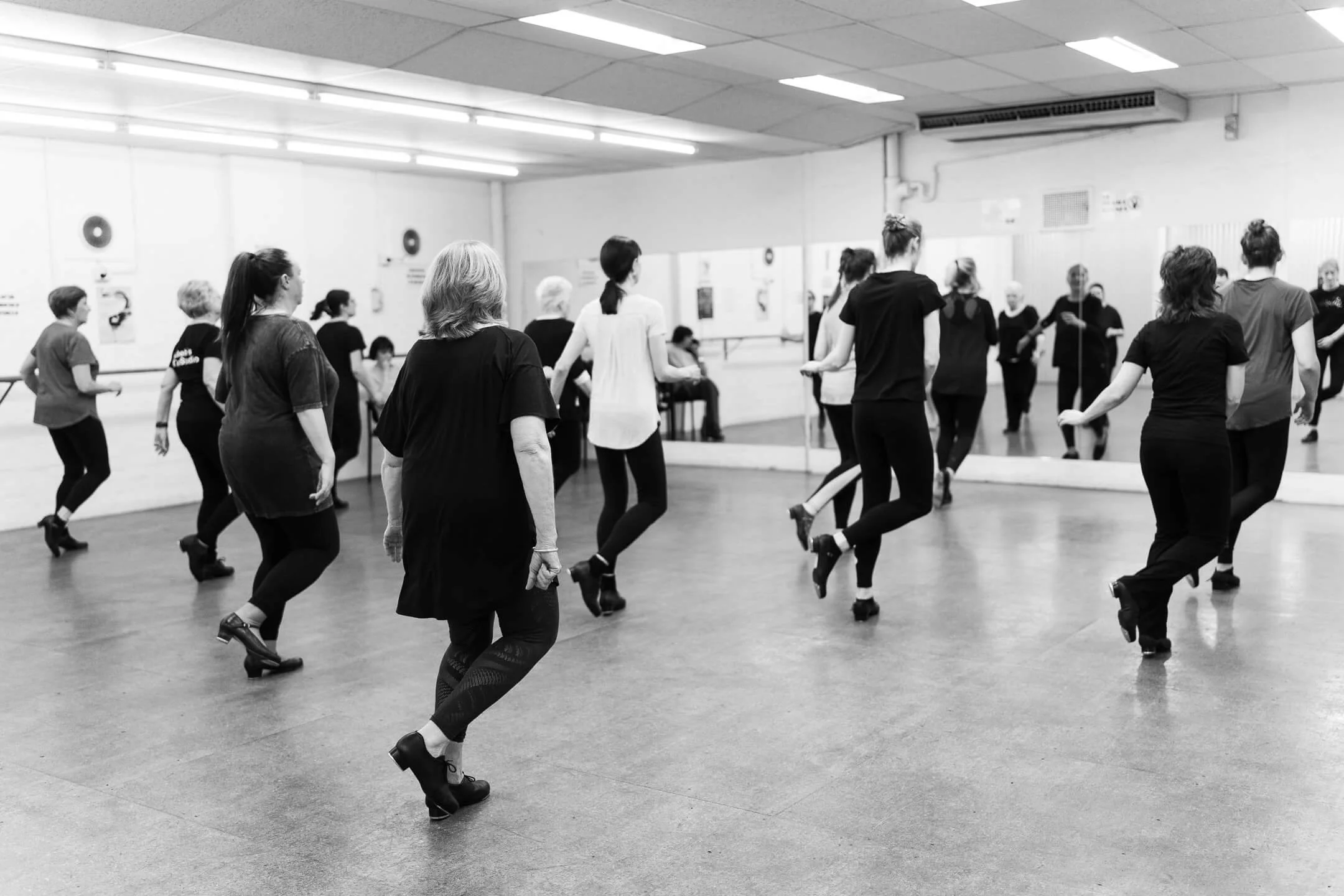
If you've ever stood in an adult tap dance class, nodded along while the teacher demonstrated a step, thought yes, I've got this, and then watched your feet do something completely unrelated to what your brain just decided, you are in very good company.
This is the most universal experience in adult tap dance. It happens to beginners. It happens to people who've been dancing for years. And there is a completely legitimate neurological reason for it that has nothing to do with your coordination, your rhythm, or whether you are, as you may have privately suspected, simply not built for this.
You are built for this. Your brain is just doing something genuinely difficult, and it's worth understanding what that actually is.
Table of Contents
What's actually happening in your brain learning tap dance as an adult
When you learn a new tap step, your brain isn't just filing away a simple instruction. It's building a new movement pattern from scratch, recruiting neurons, firing signals down unfamiliar pathways, and trying to coordinate your feet, your weight, your timing, and your ears all at once.
In the early stages of learning any new movement, the brain requires significantly more neural resources than it will once the movement becomes automatic. It's essentially working overtime. Multiple areas of the brain are involved simultaneously, the parts responsible for planning movement, processing what you're seeing, managing timing and rhythm, and monitoring whether what you're doing matches what you intended to do.
That last part is the crucial one. Your brain is constantly comparing the movement you meant to make with the movement you actually made, and in the early stages, that gap can feel enormous. Your intention is crystal clear. Your feet, apparently, have other ideas.
This isn't a coordination problem. It's a neural pathway problem. And neural pathways, unlike coordination, are something you build with repetition.
Why tap dance is particularly demanding
Most forms of exercise ask your body to repeat familiar movement patterns, walking, running, pushing, pulling. Your brain has been running those programs for decades and they're deeply embedded. Tap dance asks something different.
It asks you to create sound, with specific parts of your foot, in a specific sequence, at a specific time, while also moving through space, while also listening to music, while also remembering what comes next.
That is genuinely a lot of things to ask a brain to manage simultaneously. Learning a motor sequence requires dynamic interactions between multiple brain structures, and the initial phases of learning demand significantly more neural resources than once the movement becomes automatic. In plain English, hard things feel hard because they are hard. That's not a personal failing. That's just how brains work.
The other thing worth knowing is that tap dance asks your feet to do things they have likely never been asked to do before. Isolating a heel drop from a toe drop, understanding the difference between a brush and a flap, controlling the weight transfer in a ball change, these are genuinely new movement patterns, not variations on something familiar. Your brain is building those pathways from scratch, and that takes time and repetition.
Once you have these basics, you can start linking them together into short, rhythmic sequences. Over time, you’ll develop stronger control, speed, and musicality.
The good news about repetition
Here's what happens when you keep showing to classes.
Every time you practise a step, the neural pathway for that movement gets a little stronger. The signals travel a little faster. The gap between what your brain intends and what your feet actually do gets a little smaller. And at some point, and this point always comes, even when it feels impossibly far away, the step stops requiring conscious effort and starts feeling automatic.
That shift is one of the most satisfying things in tap dance. The moment a step you've been wrestling with for weeks suddenly just works. Not because you thought harder about it. But because your brain finally built the pathway it needed.
The stabilisation of newly learned motor skills relies on changes in brain connectivity during and after learning, essentially, your brain is doing consolidation work even when you're not in class. Sleep helps. Rest helps. Coming back the following week and running the step again helps most of all.
What to do when your feet won't co-operate
The most common mistake adult tap students make when a step isn't working is trying harder. More concentration, more intensity, more frustration, none of which help and most of which make things worse.
What actually helps is slower and less glamorous. Break the step down into its smallest components. Do just the foot, without worrying about the timing. Then add the timing, without worrying about the arms. Then put it together. Give your brain one new piece of information at a time rather than demanding it process everything simultaneously.
It also helps to know that the feeling of chaos, the sense that all the information is coming at you too fast and nothing is landing, is not a sign that you're failing. It's a sign that your brain is working. Learning new movement patterns as an adult is demanding in a way that most other activities simply aren't. The fact that it's hard is the point.
The thing nobody tells you
Most adult tap students expect the feet-brain disconnect to go away after the first few classes. It doesn't entirely, it just changes. The steps that confused you in week one will feel automatic by week six. But by week six, you'll be working on new steps, and the confusion will be fresh again.
This is not regression. This is progress. It means you're always at the edge of what you can do, which is exactly where learning happens.
The students who stick with tap dance are the ones who make a kind of peace with that feeling. Who learn to find it interesting rather than defeating. Who understand that why won't my feet do what my brain wants is not a sign that something is wrong, it's a sign that something genuinely new is being built.
And one day, without quite knowing when it happened, the step will just be there.
Frequently Asked Questions
-
Yes and no. And there's a good reason for that. Adult tap dance asks your brain to build entirely new movement patterns while managing rhythm, timing, and coordination simultaneously. That's genuinely demanding. But the difficulty is exactly what makes the progress so satisfying when it comes.
-
Because your brain is building brand new neural pathways from scratch. In the early stages of learning any new movement, your brain is working significantly harder than it will once the step becomes automatic. Every time you practise, those pathways get stronger. It gets easier, it just takes repetition.
-
There isn't one. Adults start tap dance at every age, their twenties, forties, sixties and beyond. The body adapts, the brain builds new pathways, and the progress is real at any age. The only age that's too late is the one where you stop showing up.
-
Most adult tap students notice real improvement within six to eight weeks of consistent classes. The steps that felt impossible in week one start to feel automatic by week six. Progress is real, even when it doesn't feel like it in the moment.
Ready to give it a go?
If you're ready to experience this for yourself, you can find adult tap dance classes in Melbourne at The Melbourne Tap Studio, there are classes for Beginners right through to more Advanced levels.